Showing posts with label SAKS. Show all posts

Friday, March 26, 2010

Helping Out in Haiti

Some of the gear collected for donation to the hard hit Haitian radios
and taken to Haiti by Jim Ellinger
Cases to bring the gear down.
                                      

This is what the radio station looked like after the quake.
                                       
Repaired antenna is set in new concrete.
   
Hoisting the guy wires.

It's up!

The console.

       
On the air!!!!


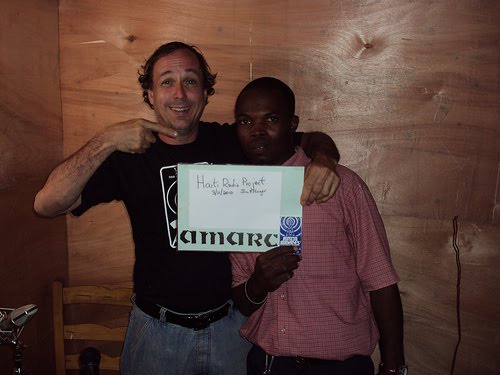
Thanks AMARC!!!


Thanks Jim!

Monday, February 1, 2010

Jane Regan's Videos on Haiti Community Radio

http://www.youtube.com/user/JaneRegan
A visit to Radyo Zetwal Peyizan (Radio Star of the Peasant) in Fondwa, Haiti, and an interview with the director to talk about how the earthquake destroyed the radio and about the importance of community radio stations in Haiti. The visit was carried out by SAKS (Society for the Animation of Social Communication), a small non-profit that works with community radios and promotes popular communication in Haiti and is part of the AMARC's Haiti emergency response efforts -http://www.amarc.org/index.php?p=Haiti_solidarity_FR (less info)


http://www.youtube.com/watch?v=--gHkdYklZQ

Sunday, January 31, 2010

SAKS Radio Director Issues Collective's Statement


link to full statement:

HAITI: AFTER THE CATASTROPHE, WHAT ARE THE PERSPECTIVES ?

Thanks to Greg Chamberlain for forwarding this Public Declaration by progressive civil society organizations in Haiti

It represents a strong current of thought among left-leaning Haitians who are both grieving and mobilizing, but are also deeply concerned on a political level, by the widely perceived failure to date of the Preval government to speak out to the Haitian people and the world -- to lead, as they see it; by the US military focus on 'security' vs. food aid in the immediate days after the earthquake -- and the continued US military control of logistics in the humanitarian response; and their concerns about global discussions related to 'rebuilding Haiti' that they feel reflect a neoliberal economic agenda of globalization and not a national agenda developed by Haitians for Haitians. - AC

Excerpt:

The emergency aid effort we are involved in is alternative in character and we expect to advocate a method of work which will denounce the traditional practices in the field of humanitarian aid which do not respect the dignity of the victims and which contribute to the reinforcement of dependency. We are advocating a humanitarian effort that is appropriate to our reality, respectful of our culture and our
environment, and which does not undermine the forms of economic solidarity that have been put in place over the decades by the grassroots organizations with which we work....

...Massive humanitarian aid is indispensable today, given the scale of the disaster, but it should be deployed in terms of a different vision of the reconstruction process. It should connect with a break from the paradigms that dominate the traditional circuits of international aid. We would hope to see the emergence of international brigades working together with our organizations in the struggle to carry out agrarian reform and an integrated urban land reform programme, the struggle against illiteracy and for reforestation, and for the construction of new modern, decentralised and universal systems of education and public health.

We must also declare our anger and indignation at the exploitation of the situation in Haiti to justify a new invasion by 20,000 U.S. Marines. We condemn what threatens to become a new military occupation by U.S. troops, the third in our history. It is clearly part of a strategy to remilitarise the Caribbean Basin in the context of the imperialist response to the growing rebellion of the peoples of our
continent against neo-liberal globalization. And it exists also within a framework of pre-emptive warfare designed to confront the eventual social explosion of a people crushed by poverty and facing despair. We condemn the model imposed by the U.S. government and the military response to a tragic humanitarian crisis. The occupation of the Toussaint Louverture international airport and other elements of the national infrastructure has deprived the Haitian people of part of the contribution made by Caricom, by Venezuela, and by some European countries. We condemn this conduct, and refuse absolutely to allow our country to become another military base.

As leaders of the organizations and platform who have set this process in motion, we are writing to share our initial analysis of the situation. We are certain, and you have already shown this to be true, that you will continue to support our work and our struggles in the framework of the construction of an alternative from which our country can rise again from this terrible catastrophe and struggle to break free of the cycle of dependency.

For the Coordinating Committee:
Sony Estéus Director of SAKS

Friday, January 29, 2010

Community radio stations obliterated, off the air in Haiti

See below for AMARC Correction to this CPJ Story!

Women sell fruit in Jacmel, where Radio Fondwa was completely destroyed along with much of the city’s downtown. 


By Jean Roland Chery/CPJ Haiti consultant
More than two weeks after earthquake that devastated Haiti, several community radio stations are still off the air. In the western and southeastern parts of the country, at least 16 stations are facing serious problems that have suspended their broadcasts, Sony Esteus, executive director of SAKS, a local organization of community radio stations, told CPJ. The earthquake obliterated SAKS’ office in the Bourdon neighborhood, east of Port-au-Prince.

Community radio stations play a leading role in local news coverage in Haiti’s most remote communities, filling the void left by private radio stations in the capital. Most of them operate with low power transmission equipment—between 10 and 500 watts. SAKS has a network of around 30 community radio stations throughout Haiti and has made bringing them back into operation its priority.

AMARC
Esteus, also a 1992 CPJ International Press Freedom awardee and the Caribbean representative of the World Association of Community Radio Broadcasters, said the premises of Radio Fondwa in the city of Jacmel and Radio SAKA in Gran Goave were completely destroyed by the earthquake. No casualties were reported, he said, adding that two Fondwa reporters who were in station’s studio when the earthquake hit escaped unharmed.

In Petit Goave, Radyo Kolf Pye, a community radio station in the town of Value suffered great losses; in Leogane, the facilities of Radio Zetwal Peyizan collapsed, Esteus said.

Esteus, an experienced radio reporter, worked for Radio Haiti Inter for almost a decade till the station was closed in 2003. During the military coup of September 1991, while he was working as a reporter for radio Tropic FM, he was imprisoned and beaten at the headquarters of the in Port-au-Prince police department, he told CPJ.

From the Committee to Protect Journalists

 If you have any information on journalists and media outlets in Haiti please go to Committee to Protect Journalists or notify via e-mail msalazar@cpj.org, or Twitter: @HelpJournalists. They are collecting funds that will go directly to Haitian journalists.
********************
From Elizabeth Robinson of AMARC: We've received some corrections to this account from Francesco Diasio, one of the AMARC team.  He writes that Radio SAKA was not destroyed (damaged) and is broadcasting from outside.  I'm posting the latest report from Marcelo Solervicens in Montreal:

THE CPJ REPORT HAS BEEN CORRECTED BY SEVERAL AMARC MEMBERS WHO HAVE BEEN ACTIVE IN THE HAITI RECOVERY EFFORTS:
Community broadcasters mobilise in support of Haiti

Community radio broadcasters are mobilising worldwide in response to the earthquake that struck Haiti on 12 January. In an unprecedented global response in solidarity with the Haitian people, community radio broadcasters have organised appeals for emergency and humanitarian relief and have offered equipment and technical expertise to support Haiti's community radio stations.

An AMARC volunteer team arrived in Port-au-Prince on Sunday carrying equipment for SAKS (Society for the Animation of Social Communication), a community media production and support centre in Port-au-Prince, whose offices were destroyed when the earthquake struck. Sony Esteus, Director of SAKS and AMARC Vice President, will accompany the international team as they travel to Leogane, Grand Goave, Jacmel and other locations that are among the worst hit areas outside of the Haitian capital.

Radio Saka, the local community radio of Grand Goave, was reported back on the air, but at reduced power, and helping to mobilise local relief efforts. AMARC estimates around 12 community radios are in areas directly affected by the earthquake. The AMARC-SAKS mission will assess the impact of the earthquake on the community radio sector, provide
basic repairs and support to community media workers, and assist community radio to contribute to the humanitarian relief operation.

In the capital, most neighbourhoods have been heavily impacted. Many hundred thousand people have been left homeless and there are thousands of temporary camps. Everything happens in the streets. "The streets are the 'salon' of the people" says an old Haitian proverb. This has become a reality, even for those whose homes have not been damaged or destroyed, with people preferring to sleep in the open rather than risk staying in a building that might collapse with the next aftershock. Even the radio stations are broadcasting on the streets, with journalists afraid to work in their studios

Major international media support organisations are on the ground working to help restore Haiti's damaged communications infratructure: AMARC, International Media Support, Internews, Reporters Without Borders, are among the organisations collaborating in Haiti to avoid duplication and to assure an effective response to the disaster and the challenges of providing immediate relief.

AMARC has called on community radio broadcasters worldwide to support the Haiti relief effort, not only by broadcasting humanitarian appeals, but also be providing equipment, technical support and other resources to enable community radio in Haiti to play a central role in assuring access to information and enabling the populations affected to communicate their needs and concerns.

For news updates, further information and offers of equipment, technical and other support to assist community radio in Haiti, please visit:  http://www.amarc.org/haiti

Through service to members, networking and project implementation, the World Association of Community Radio Broadcasters AMARC, brings together a network of more than 4,000 community radios, Federations and community media stakeholders in more than 115 countries. The main global impact of AMARC since its creation in 1983 has been to accompany and support the establishment of a world wide community radio sector that has democratized the media sector. AMARC advocates for the right to communicate at the international, national, local and neighbourhood levels and defends and promotes the interests of the community radio movement through solidarity, networking and Cooperation.

Sunday, January 24, 2010

Message about Community Radio in Haiti from AMARC


To all of you who have made offers of help through AMARC, the following is a report we prepared a couple of days ago. Our team is now in Port au Prince and should be reporting back preliminarily by the end of this week. Meanwhile, we are gathering information regarding resources that may be available for efforts in the next 2 months or so. If you have equipment and/or time & technical skills, please let AMARC in Montreal know. It would be helpful to know exactly what equipment or skills you have, whether you are free and willing to travel, whether you can support yourself or have support from a station or organization, and your location. Thanks again for your help and interest.

Elizabeth (Robinson)
AMARC/SAKS Urgence-Haiti Update #2, 21/01/10
For more information and to contact AMARC visit: http://www.amarc.org/haiti

Headlines
- SAKS office (PP) destroyed, staff alive and well, contact re-established by email and phone

- REFRAKA office (PP) destroyed, staff alive, one injured
- At least 12 community radio stations assessed to be strongly or severely affected
- First AMARC/SAKS Urgence-Haiti international mission to arrive Port-au-Prince 24/01/10
- Immediate priority to assess worst affected areas including Grand Goave, Petit Goave, Leogane
- Unprecedented response in offers of support from international community radio movement

Detail
SAKS (Sosyete Animasyon ak Kominakasyon Sosyal) - office (34 rue
Dalencourt, PP) was totally destroyed, re-established telephone contact on 18/01 with Sony Esteus, Executive Director SAKS and Vice President AMARC, all staff reported as alive and well, re-established email contact with Sony on 19/01. Communications remain difficult and intermittent. Seeking to establish temporary office.

REFRAKA (Haiti Community Radio Women's Network) - office (36 rue Dalencourt PP) was totally destroyed, one member of staff, Marie Guyrleine Justin, reported as injured.

Community radio stations - 12 stations identified as being in strongly or severely affected areas including 6 AMARC members - Radyo Saka (Grand Goave),
Radyo Zetwal Peyizan (Leogane),
Radyo Echo (Petit Goave), Radyo
Kominote Klofa Pye (Vallue, Petit Goave),
Radyo Flanbo (Cayes Jacmel),
Radyo Kominote Bel Ans (Belle-Anse) -
and 6 other community radio stations
identified - Radyo Boukman (Cite Soleil, PP),
Radyo Kenskoff Inter (Kenskoff),
Radyo Men Kontre (Petit Goave), Radyo Azuie Inter (Fond
Parisien), Radyo Fondwa (Fondwa) and
Radyo La Vallee Jacmel (La Vallee, Jacmel).

Radyo Fondwa report of building destroyed and two staff died.
Reports of Radyo Saka journalists involved in local relief organisation.
No other news from the above despite repeated attempts to contact by phone and email.
Of 40 other community radios in Haiti, a further 8 are nearby and may have experienced moderate effects and/or are in areas where significant numbers of people are seeking refugee. AMARC has prepared a list of 20 community radio stations to prioritise with immediate attention to worst affected areas outside PP.
See http://www.amarc.org/haiti" for a map, impact assessment, and contact details for the radios.

International mission - Preparation underway in Santo Domingo. For the first mission we have a team of 5 people: Eduardo Garcia (UDECA/Radio Santa Maria/ALER) and Adoniz Mendez (Radio Santa Maria) are in Santo Domingo and assisting with logistics (transport etc). Francesco Diasio (Amisnet/AMARC-Europe) and Jane Regan will arrive in Santo Domingo on 23
January. Sony Esteus is in Port-au-Prince and arranging local logistics.
This is an assessment mission with some basic repairs capability and small items including one emergency replacement FM transmitter, repair kits, reporter kits, netbooks.

The mission is scheduled to travel into Haiti on 24 January and will aim to coordinate with other media support organisations in PP on 25 January, before commencing assessment visits outside PP. Objectives to assess the status of the community radios and their personnel, to assure (where possible) their integration into the humanitarian information network (including basic repairs and basic guidance on humanitarian relief reporting), to assist re-establishment of SAKS community radio support
centre.

Immediate priority is to travel outside Port-au-Prince to a cluster in some of the worst affected areas - around Leogane, Grand Goave and Petit Goave - where there are 5 community radios. After that, to visit other clusters of radios in areas badly affected - including La Vallee Jacmel, Cayes Jacmel, Fondwa, Belle Anse, Grand Saline, Kenscoff, Fonds Parisien and Verette - then return to Port-au-Prince.

The first assessment mission is to be completed by 2 Feb but Francesco will remain in the field to provide additional support to Sony/SAKS and to prepare the ground for further incoming support.

Unprecedented international media solidarity - initial mission is a multinational effort with mission team volunteers from US, Italy, Dominican Republic and Haiti, supported by AMARC offices in Montreal, Buenos Aires, Rome, Kathmandu and with partners and supporters including ALER (Latin America), Amisnet (Italy), FMYY (Japan), BHN (Japan), Austin Airwaves (US), Combine (Indonesia), UDECA (DR), Radio Santa Maria (DR), Radio Enriquillo (DR), Free Voice, Open Society Institute. Offers of
technical support and international volunteers have been received from all continents. BHN, a Japanese communications NGO with extensive emergency experience, are sending two technical experts to arrive Haiti 23 or 24 Jan, for initial assessment with potential follow-up to provide community mini FM radio station, distribution of radio receivers, simple community
address system with loudspeakers and microphone. Combine, Indonesian community media NGO with experience in Aceh and Yogjakarta, have offered technical expert with disaster relief communications experience and FM broadcast equipment. Austin Airwaves (Texas) have offered an international volunteer to bring and install a complete FM broadcast unit including antenna. Free Voice have offered to provide emergency replacement equipment and technical assistance. Free Voice and Open Society Institute providing joint financial support to initial emergency response.

For further information follow: http://www.amarc.org/haiti
Contacts for first mission:
Francesco Diasio fdiasio (at) amisnet

Jane Regan jane (at) janevregan.org


AMARC International Secretariat (Montreal) Marcelo Solervicens, Secretary General secgen (at) si.amarc.org

AMARC Latin America and Caribbean (Buenos Aires) Paula Castello, Projects Coordinator paulacastello (at) amarc.org

Elizabeth Robinson KCSB 91.9 Associate Director for Media Associated Students University of California Santa Barbara
elizabeth.robinson (at) kcsb.org AMARC (World Association of Community Radio Broadcasters),

RSF CS 90247 - 75083 Paris Cedex 02 

Tuesday, January 19, 2010

More on Community Radio in Haiti

By TAMARA LUSH, Associated Press Writer Wednesday, January 20, 2010
(01-20) 06:54 PST PORT-AU-PRINCE, Haiti (AP) --

The caller from Boston was desperate.

She had just received a text message Tuesday from a friend trapped in the rubble of a Port-au-Prince school and needed to get the news to rescuers, the Haitian government, the world.

She called the right place: Signal FM, the only radio station in the city that has broadcast nonstop during the earthquake. Its building, transmitting equipment and antennas escaped damage, and the station has been a key source of information since the magnitude-7 temblor wrecked Haiti a week ago.

Day and night, journalists and disc jockeys announce names of missing persons and news of open stores and dead celebrities, while calmly taking frantic calls and e-mails from both home and abroad.

Outside, people crowd the station's parking lot with crumpled handwritten notes, pleading for the announcers to read the names of their missing loved ones or a location where hungry people need relief.

"The radio station is the people's life right now," said 56-year-old Roselaure Revil, a Haitian who runs a small church aid program that is out of food, water and clothing. "Without the radio station, the country is dead. Without the radio station, we can't communicate. We don't have anything."

Even before the earthquake, radio was the nation's most popular form of media. About half of Haitians are said to be illiterate, so they can't read newspapers, and a lack of electricity in many households means television is not an option...
******************************


Short but Welcome Message from AMARC Vice President:
Sony Esteus has written that he is alive. He was out of touch for six long days. Not much is known about his condition, but this message was received!
"Thank u all. I'm alive."
Sony ESTEUS


and about aid to Haitian stations:
WMNF Community Radio to Hold Emergency Fundraiser for Haiti Relief Organizations
WMNF is trying to raise as much money as possible, and will split the funds evenly between four organizations: Wyclef Jean’s Yele Haiti, Doctors Without Borders, Partners in Health and Mercy Corps. WMNF will receive no proceeds as a result of the funds raised. 100% of the contributions will go to these relief groups.
WMNF News Director Rob Lorei says 88.5fm listeners are very generous and have helped out in other such efforts.
“WMNF listeners are very community-minded and they’ve been telling us about their deep concern for the people of Haiti. In the past, when we raised funds for the victims of Katrina, we raised a lot of money for relief. There’s no telling how this will turn out- given our economic problems here at home- but my guess is that they will come through in a big way,” said Lorei.
In 2005, WMNF held a fundraiser for Hurricane Katrina victims. >> As it is doing this time, the FCC lifted a ban on fundraising for other non-profit organizations so that public and community radio stations could hold special on-air pledge drives. <<
In one day, WMNF raised $132,000 that was split evenly among four non-profits. Our members thanked us time after time that day for putting their money toward trust-worthy non-profits to rebuild the areas and lives ravaged by Katrina.

••••••••••••••••••••••

From South Africa:
We are working flat out on a Haiti response right now, spearheaded by Michelle. At this point, our donor does not want any technical assistance, but knowing you're there could be very helpful to us. At this point I just don't know. We will be involved in both the emergency response as well as reconstruction efforts later. Michelle will contact you as soon as she can.

Kind regards and thank you very much for your email and offer of assistance. Radio will be extremely important in the coming months.
Kristine P__ | Chief Executive | Freeplay Foundation

Sitemeter