Sunday, January 2, 2011

Art of Resistance in Haiti


AS IF Gallery is proud to present the art works of the children's group, Ti Moun Rezistans, whose studio is at the Atis Rezistans art school in Port-au-Prince, Haiti. Complementing the children's work will be a small selection of Daniel Morel's iconic photographs of the children and their surroundings in the throws of the Haitian earthquake which took place in January, 2010. Also included is Les Indiens, a large-format photograph by Phyllis Galembo, depicting four children in contemporary ritual costumes from the Jacmel Carnival in Haiti in the decade before the island's devastation.
On January 12th, 2010, Daniel Morel was busy photographing the artwork of the children of the Atis Rezistans in the courtyard of their school in Port-au-Prince when the historic 7.0 earthquake struck. His pictures of the moments just before and after the devastation became the most widely distributed and iconic images of that disaster. But the passage of these photographs to global prominence was far from smooth. As powerful aftershocks rocked the city, Morel made his way along the shattered Grande Rue to the still standing Oloffson Hotel, photographing the wreckage and pandemonium that he witnessed en route. At the hotel Morel connected to the internet, created a web account, and directly uploaded his pictures to facilitate their instant dissemination to news media and wire services worldwide. Morel hoped to show the unimaginable scope of the destruction even as it was occurring, so that the task of organizing aid could begin without delay. His staggering pictures of flattened structures and shocked, dust-covered survivors appeared throughout the world within hours, and came to define the Haitian disaster as it was unfolding.
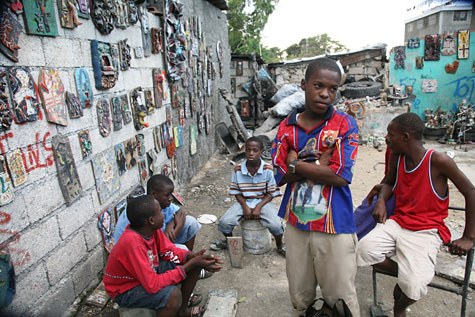
Daniel Morel, Ti Moun Rezistans at Atis Rezistans Art School, Port-au-Prince, Haiti, January 12, 2010, C-print

Ti Moun Rezistans is the name of a Haitian children's group in Port-au-Prince who study art with the more established members of the Atis Rezistans collective, also known as the Grand Rue Sculptors. Atis Rezistans was founded in 2000 by the artists Jean Hérard Celeur and André Eugène, and set up at the south end the Grande Rue, in a close-knit neighborhood where traditional handicraft workshops are hemmed in by car repair outfits, scrap metal dealers, and junkyards. Over the last decade the Grand Rue Sculptors have exhibited their work throughout the world to considerable acclaim. "Their powerful sculptural assemblages made from engine manifolds, TV sets, wheel hubcaps and discarded lumber have transformed the detritus of a failing economy into bold and radical sculpture. They reference a shared African/Haitian cultural heritage, a dystopian sci-fi view of the future and the transformative act of assemblage." (Atis-rezistance website) Ti Moun Rezistans was established to expand the horizons, powers of expression, and most importantly, the earning capacity of the impoverished children of Port-au-Prince. The children of Ti Moun have also exhibited their artworks widely and sell them directly through their own email addresses, websites and in person at the Atis Rezistans studio in Port-au-Prince. 


29 Manhattan Avenue, New York, NY 10027
(AS IF Gallery is located at the NW corner of 122nd Street and Manhattan Avenue on the ground floor)
www.asifgallery.com

Saturday, January 1, 2011

Youth Group in Afghanistan Reaches Out for Peace


For the last several years, a group of young Afghani’s in the Bamyan province of Afghanistan have been on “Our Journey To Smile” (http://ourjourneytosmile.com/blog/).  This journey to smile is their effort to bring about peaceful nonviolent solutions to conflicts in Afghanistan using the principles taught by Jesus, Gandhi, Martin Luther King, Jr. and others.object height="305" width="420">
Afghanistan – The People’s

Afghanistan – The People’s December Review

December 27, 2010 by  
Filed under Journey Updates
Afghanistan – The People’s December Review
December 25, 2010
abdulais-love
Abdulai
Afghanistan – The People’s December Review
December 25, 2010
In the first person voice of Abdulai, a fifteen year old Afghan boy whose father was killed by the Taliban:
“The place where I live is the worst place on earth in which to be born[1]. Good thing my mother survived her pregnancies[2]. But my father — he didn’t survive the war. Isn’t it strange that there is a graveyard marked out especially for children in my small remote mountain village? A quarter of all children do not live beyond five years of age[3] and they are buried there; we already have to find new space because the graveyard is filled. As 42 percent of Afghans live in poverty[4], my family could not afford a proper grave for my father for five years. My father would have understood our predicament: in a land with the worst food risk in the world[5], we make do with whatever food and clean water[6] we can get. Since we don’t have electricity[7], we are grateful for diesel lamps. And most importantly, my father would have understood that we still struggle to stay away from the killings.
Since War World II, wars have killed mainly civilians[8] and this war in Afghanistan is no exception. In fact, we now have nowhere to turn[9] and nowhere to hide[10]. We face night raids[11], computerized aerial bombings[12] and the armed players who neither recognize our language nor our faces.
Many of our families and friends have sought refuge in far-away places[13]. What can our people do? Wait to die of sickness or violence? Be pawns in the warlords’ games? I made hand-sewn leather cell-phone peace pouches for our ‘brothers’ and ‘sisters’ in Kandahar and I know that before the NATO commander had launched the current offensive there, 94% of Kandaharis said they wanted peace talks[14], not war. But the US led coalition went ahead and launched its deadly military operation. They proved their utterly un-democratic, unimaginative addiction to an unchanging military solution.
Karzai said that more than 42 percent of children in Afghanistan still have no access to schooling[15]: at least, that’s not as fatal as the three children killed daily in the conflict last year[16]. If you don’t grasp how the Afghan state is the third most corrupt in the world[17], come take our school exams to experience the rampant bribery and cheating this war encourages. Like other war-torn countries, the influx of weapons and un-accounted monetary aid fosters corruption, fuelling deceit at all levels of our society.
Drugs made from poppies grown in our country are everywhere, with more than a million drug addicts in country[18]. Perhaps, being doped is better than putting up with our sheer lack of work and recourse to government services or justice. Last year, estimates are that we Afghans had to pay $2.49 billion dollars in bribes to our own government officials[19], which is equivalent to 23% of our country’s GDP.
But heck it….we don’t even want your money! Two billion of which you spend on the military weekly[20]and the remaining dirty trickle cannot even be accounted for by your Special Inspector General for Afghanistan Reconstruction (SIGAR)[21].
My mother and sister say to you that you can forget about promoting ‘women’s rights’ with your uniformed pride. Last year, there were 2300 suicides related to depression among women and girls[22]. And don’t ever claim that a military strategy can stop them from taking their lives. Neither the US-NATO coalition nor our warlords can, with their violence, stop the desperation of our people. In fact, like the people caught in the Helmand operation that was declared a success, the women of Afghanistan want you, with full responsibility, to transition out as soon as possible[23].
President Obama, please completely rethink the ‘progress’ you declared in the December review[24]. To Ms. Hillary Clinton and Mr Robert Gates, we’re sorry for your dismissal of world public opinion[25]. Now, get ready for its flood![26]

[1] In 2010, Afghanistan had the 3rd highest infant mortality in the world . In 2009, UNICEF declared Afghanistan the worst place on earth to be born in.
[2] In 2010, Afghanistan had the 2nd highest maternal mortality in the world.
[5] Afghanistan tops the list of 163 countries which face the risk of food shortages in the “food security risk index” compiled by global analysts Maplecroft.
[9] Call by 29 NGOs to end night raids and the stop the Afghan Local Police program in Nowhere to Turn”.
[11] Gen. David Petraeus released totals for the alleged results of nearly 3,000 “night raids” by Special Operations Forces (SOF) units over the 90 days from May through July
[12] Up till December, coalition aircraft have used 4,615 bombs and Hellfire missiles in 2010. Every Hellfire missile fired in Afghanistan costs USD58,000.
[13] See UNHCR figures on Afghan refugees
[17] Transparency International, a Berlin-based corruption watchdog, ranks Afghanistan the third most corrupt state in the world in 2010.
[18] United Nations Office on Drugs and Crime (UNODC) report found that around one million people in the country aged 15 to 64 had drug addictions
[19] A UN report said that in 2009, Afghan citizens had to pay approximately $2.49 billion in bribes,
[20] The annual cost of the war is $113 billion
[21] Special Inspector for Afghanistan Reconstruction (SIGAR) Arnold Fields had to say:”It is outrageous that the US government can’t even determine the amount we pay to support Afghan government employees or how many people are paid
[22] The advisor of the president of Afghanistan in health matters estimates that each year 2300 Afghan women and girls commit suicide
[23] See Afghan Women Speak by David Cortright of Kroc Institute
the-people-raise-their-voices
The People raise their Voices
This People’s December Review sought to speak from the ‘hearts and minds’ of ordinary Afghan people, commoners who share the same pain experienced by the impoverished and unheard masses everywhere.
It is a reflection of life as it really is for the people of Afghanistan.
The world should listen.
The people of the world should be listening to one another, because governments are not.
President Obama declared in his administration’s December Review that there was ‘significant progress’ for America’s goals in Afghanistan.
He claimed to be ‘on track.’
But, Abdulai’s People’s December Review shows how far off-track Obama is from the people’s concerns and how U.S. foreign policy gives no alternative options for any citizen.
There ARE alternative options and views, a small number of which we’ve listed below, starting off with Prof. Noam Chomsky’s views expressed in the Afghan Youth Peace Volunteers’ recent conversation with him.
In the bigger scheme of history, for too long now, the strategies for resolving global conflicts have been built predominantly around military force.
Soul-force must be given a chance.
what-do-the-people-want1What do the people want?
A Sample of Alternative December Reviews
Excerpts of interview with Prof Noam Chomsky
In a conversation with the Afghan Youth Peace Volunteers on the 17th of December 2010 for The People’s December Review.
On Obama’s claims of ‘significant progress’
…it’s worth noting that a few days ago the International Commission of the Red Cross released a report which is extremely unusual for them, -they rarely do it,- in which they said that the situation on the ground has deteriorated radically. They gave particulars and said it’s now far worse than it’s been in the past. They’re actually working there and have experience. Plainly that’s not consistent with the picture of progress.
On self-determination by the people
I know for me at least and the people I work with in the antiwar movement the goal for Afghanistan would be for Afghans themselves to take over the planning, the determination of what will happen ,so that there won’t be a review conference in Washington where they have their own goals, –the welfare of the people of Afghanistan is not high among them,– but rather the decisions will be made by people like you and others in Afghanistan who have the fate of your country and your lives at heart and people of the US here should support your efforts in whatever way we can.
….But there is extensive study that demonstrates that there is a very wide gap between the decisions of the government and the will of the population. That’s true on domestic issues. It’s true on international issues, and it reflects the fact that though the U.S. is an unusually free country by comparative standards, it’s only in a very limited way a functioning democracy.
Power does not lie in the hands of the population except in a very limited way and popular opinion does not determine policy. And that’s in fact one of the reasons why there’s such hysteria over the leaks of government documents. Anyone who has studied secret documents for many years, as I have, knowsone of their main purposes is to protect the government from the population, not security, but just keeping the public controlled and obedient. That’s a battle that has to be constantly fought in the more free societies as well to try to overcome this dysfunctional element of formal democracy which keeps it from functioning properly. Popular movements have in the past and should in this case too integrate themselves with those of other countries and form a common force, often against their own governments.
On reparations
Afghanistan has a very dramatic, important history of independence, but for the last thirty years it has simply been a plaything of the great powers which have virtually destroyed it. All of them. All of the ones who were involved owe Afghanistan not aid but reparations. Apology and reparations. That includes Russia, of course, and certainly the United States and it also includes Pakistan. Aid sounds like something we give out of our good nature or good will. Reparation means what we are responsible for providing because of the extreme damage we have caused. And yes, that‘s a very important demand. It should be made here and should be made in Afghanistan.
On the question of U.S. intentions in Afghanistan: eventual withdrawal or permanent presence?
At this point, I think it’s not unlikely that even just for domestic, political reasons, the U.S. will try to find a way to withdraw most of its forces and try to portray it as some kind a victory. That’s for domestic reasons.
But, I don’t think that’s what should concern us. We’re not concerned with making officials in Washington look good to their associates.
We should be concerned with what matters for the people of Afghanistan. And that’s of course for you and others like you to decide. Success, I would understand as meaning success in achieving your aims, not Washington’s aims.
On what Afghan and international peace activists should focus on
What Afghans should focus on is finding ways to join together to formulate their own ideas and plans as to the course of policy, internal to Afghanistan, and their demands on other countries that are engaged in Afghanistan. That means primarily the US but also others that are involved.
Afghans should formulate those goals and policies jointly with people in the rest of the world, in particular in the United States that work to support those plans, so the activists in the United States should be and to an extent are waiting to hear from people of Afghanistan. What do you want us to do?
the-people-look-for-alternative-solutions-to-their-floods
The People look for alternative solutions
to their ‘floods’
A Sample of Alternative December Reviews
“So what’s my option?” the president asked his war cabinet, seeking alternatives…
You have essentially given me one option. …It’s unacceptable.”
Obama’s Wars, Bob Woodward
“Why not talks?”
“Why not reconciliation?”
“Why not non-violence?”
1. World Public Opinion Polls
Hillary Clinton and Robert Gates tried to belittle this significant public opinion. Read how they dismissed public opinion and democracy.
2. Letter from Afghan Experts to Barack Obama
3. National Intelligence Estimates NIE
4. Other Studies/Reports
A New Way Forward: Rethinking US Strategy in Afghanistan published by Washington-based Afghan Study Group
“Strategic Survey 2010″ released by the London-based International Institute for Strategic Studies
Both studies above conclude that “a Taliban takeover is unlikely even if Washington reduces its military commitment” in Afghanistan, in good measure because the conditions that allowed the first Taliban takeover in the 1990s no longer exist and can’t easily be repeated. As important, “there [are] no significant Al Qaeda presence in Afghanistan today, and the risk of a new ‘safe haven’ there under more ‘friendly’ Taliban rule is overstated.”
Afghan Women Speak by David Cortright of Kroc Institute which expresses Afghan women’s recommendations to the US and NATO governments for a responsible withdrawal.

Wednesday, December 29, 2010

Oregon reservation radio shows power of tiny station

http://www.kcuwradio.org/


Dec. 29, 2010, 3:19 p.m. PST                                          Associated Press   PENDLETON, Ore. (AP) — One of Bill Young's earliest memories is listening to Elsie Conner tell him stories about Coyote as he fell asleep.  As an adult, he held that memory dear, even though he couldn't remember the stories themselves.
Now he is revitalizing those stories by reading them on the airwaves. Sunday through Thursday, between 9 p.m. and 10 p.m., Young's voice goes out on 104.5 FM to the Umatilla Indian Reservation. He reads stories by well-known authors, with their permission.  "I feel like I'm saying goodnight to all my neighbors," Young said.
Though Young has just started his show it's been on air for about eight weeks he hopes to build a library of stories that can be broadcast over and over, repeating the oral tradition via the radio waves. The show, called "Good Night Rez," is one of many broadcast on KCUW, the low-power FM radio station of the reservation.  Its signal stretches from near Wildhorse Resort & Casino almost to Highway 11. Sometimes it can be heard as far west as the Pendleton city limits and, on a good day, as far east as Cabbage Hill.
The signal is powered with 100 watts, about the same as a bright light bulb. It is centered in a back office of the tribal public safety building on Ti'mine Way, near the large Nixyaawii Governance Center. Along with Young's show, the station broadcasts national shows and shows produced by local volunteers with a love for music, storytelling and community.  Now, more places across the nation will have the opportunity to serve their communities as KCUW does.
The U.S. House and Senate recently passed the Local Community Radio Act. It now awaits the president's signature. The bill will allow for more stations like KCUW to get licensed and serve their local communities  The Prometheus Radio Project, which helped start KCUW in 2004, was a big proponent of the bill.
"A town without a community radio station is like a town without a library," Pete Tridish with Prometheus said in an announcement on the group's website. "Many a small town dreamer has successfully launched a low-power station, and built these tiny channels into vibrant town institutions that spotlight school board elections, breathe life into the local music scene, allow people to communicate in their native languages, and give youth an outlet to speak."
KCUW DJs Daisy Minthorn and Cindy Halfmoon both said they wouldn't be able to be involved with radio if it wasn't for KCUW. Young admitted he would likely be involved in radio in some way, but KCUW offers him the freedom to do what he loves.  And it's that freedom that makes KCUW unique.
Minthorn hosts The Quiet Storm, an R&B show allowing her to indulge in her favorite music.  "I love it," Minthorn said. "I just like music new stuff that's just come out, comparing it to older stuff. Mix it up, basically."  Minthorn grew up making mix tapes and giving them to friends. Developing a radio show was a "natural step" forward.
Minthorn comes off as a quiet person, speaking softly. She said it took a few months before she felt confident enough to add commentary to her music show. She's gotten more and more bold and now takes requests via Facebook. She usually makes up her playlist a few days before the show.  It is also a nice break from her day job in the tribal housing department and serving on the Nixyaawii school board. It gives her time to relax and do something different.
Cindy Halfmoon said she looks forward to working on her show, "C-Bear Revivals," every week.  "It's a lot like exercise" Halfmoon said. "You put it off, but when you get in here it feels good."  Unlike Minthorn's show, Halfmoon mixes music and talk to tackle serious topics such as suicide prevention, gang awareness, depression and breast cancer. She also looks into timely subjects such as elections or honoring veterans.
"I see topics on the news and bring them up if they're relevant to the community in how it affects the reservation," Halfmoon said. "I don't think I'll ever run out of ideas."  She pairs these discussions with music that runs with the theme.
"There's a song for every occasion," Halfmoon said =.  Aside from the fun of hosting a show, Halfmoon revels in the opportunity to help her community.  "I've been a taker all my life," she said. "It feels good to be a giver."
Young enjoys that same sense of community when he reads stories about Coyote. They are old lessons. Lessons that don't have to do with modern life, like work and business. It teaches the importance of a secure family, of having a good hunt, of being prepared for winter.
"It allows us to live in another view of the world," he said.

Sitemeter