Monday, August 30, 2010

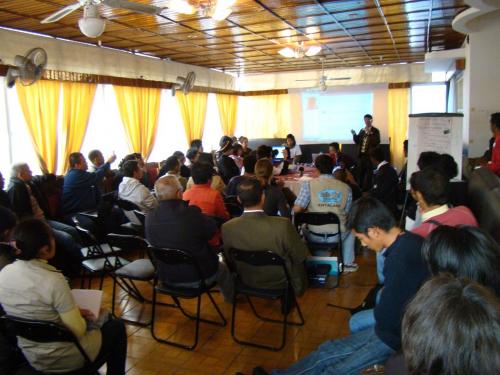
Florida Symposium to Discuss Nollywood Films

Nigerian films are the world's third biggest film industry.

One Day Symposium at the University of Florida, Ritz Union
Nigeria as a Center of Discourse: 
Re-centering a Marginal Nation-State
organized by Kole Oluwatoyin Ade-Odutola,
Lecturer, University of Florida
Friday October 1st
Program of event 9:00 to 12:45pm
(1). Arrival of Guests 9:00 to 9:30am
(2). Opening formalities and Welcome Addresses
(2.1) The Chair of LLC
(2.2) The sponsors…Center for Humanities and Center for Cultural studies
(3). Introduction of speakers/ Chairman’s opening remarks
1st Session….Nigeria in text and in context
(4) Organisation of a Modern Nigeria using indigenous wisdom by Adewale Ajadi
(5) “The Many and Changing Faces of Ogun: The Yoruba God of Iron in Florida.” …Prof.Robin Poynor
(6) Knowing Nigeria through music…Professor Bender
(7) Knowing Nigeria through creative writers…STILL OPEN
(8). 50 Years of Nigerian Literature….by Professor Ken Harrow (Kenneth W. Harrow Distinguished Professor of English, Michigan State University)
(9). Performance and presentation by Dr. Rachel Hastings
(10). Questions and responses
(11). Lunch Break 1:00pm to 2:30pm
Afternoon   Nollywood: What it is and what it is not
(12). Introduction of speakers/ Chairman’s opening remarks
(12.1) The Chair of the session
(12.2). Introduction of speakers
(13). "Religious and Surrealistic constructions in Nollywood: NEED A PRESENTER
(14). "Nollywood: A Cinema In Search Of Itself."...NEED A NEW TOPIC AND PRESENTER
3:30pm to 4:30pm (Professor L. White introduces Dr. Ambler) (Speaker sponsored by the Center for African Studies)
(15). “The Movies in Nigeria from Hollywood to Nollywood.”..Dr. Ambler
(16). Screening of 'Green Passport' (30mins)
(17) Reception at Grinter Hall (Sponsored by the Center for African studies)
After the reception…
3rd session Politics and representation (6:30pm to 9pm)
(18). Chairperson’s brief remarks
(19). (Middle Belt: People, politics,[Nigerian Middle-belt Region: The Third Force in Nigerian Politics.]…Professor Tunga Lergo
(20). Brief spoken word Performance by Dr. Rachel Hastings
(21). Screening of Professor Su O’Brien’s Documentary (65mins)
(22). Questions and responses
(23). Closing remarks
Reception

Friday, August 27, 2010

CRTC Releases Yet Another "Paternalistic" Community TV Policy

Ottawa (August 28,2010) After eight long years of complaints from the Canadian public that they have been excluded from "community TV channels" on cable, the CRTC yesterday released a new community TV policy for Canada that is little better than the existing policy.

As dissenting Commissioner Michel Morin dubs it, "The Commission’s paternalistic community model" leaves community cable channels and the money that is collected from Canadians for "local expression" firmly under the control of cable companies. Catherine Edwards, Spokesperson for the Canadian Association of Community Television Users and Stations (CACTUS) noted, "The Commission ignored the request of the Canadian public—which was made abundantly clear at these hearings—that the time has come for community broadcasting to be in the hands of communities, as it is in all Western countries that have a community sector. This is how it operates here in Canada in the community radio sector. Why not TV?"

Licences for communities to run their own channels were introduced in 2002, but there was no funding formula. The CRTC’s analysis acknowledges that a lack of funding explains why so few community licenses have been requested, yet the new policy denies communities access to the Local Programming Initiative Fund that is available to private broadcasters, denies access to commercial advertising, and denies access to the more than $120 million collected annually from Canadians for "local expression", but which instead goes to cable companies for their professional regional channels.

Edwards reflected, "What’s particularly sad is how outdated the Commission’s model of community TV is. Approximately 40% of Canadians don’t subscribe to cable, so a cable channel as a digital townhall for Canadians just doesn’t work anymore. We also presented data to show that the majority of the more than 300 unique community channels and studios that once existed on cable have already been closed. This evidence appears to have been ignored. The relatively minor tweaks to the existing policy do nothing to address the closures."

CACTUS proposed a new model of community broadcasting that would offer access to digital technologies, tools and training in every community across the country, available on all platforms, not just cable. "It’s a real missed opportunity," said Edwards.

Contacts: Catherine Edwards, CACTUS (819) 772-2862

Friday, August 20, 2010

Radio Victoria--Sigue siendo Victoria

Part 1


Part 2

Celtic Tradition in Cape Breton


Mabou - Inverness County, Nova Scotia - an unincorporated area - now defined as a school district and postal area - formerly the mail distribution point for a number of small post offices in surrounding communities each of which also had one or two room schools. It may also be defined very roughly as the area drained by two branches of the Mabou River.

While the name of the place may well be of Mikmaw (native) origin, the meaning of the word is obscure. The name was used in the 1700's. The location was known prior to the settlement by Europeans for the deposit of coal, for the headland which is today called "Cape Mabou" and for the sheltered inlet called "Mabou Harbour". The Mikmaw in their yearly peregrinations were attracted to the area by the abundance of fish - alewives, salmon and lobster - and by the natural meadows where game was plentiful - deer, moose, beaver and mink. The mouth of the river was also one of the closest places to Prince Edward Island - often visited by the Mikmaw.

Tradition hold that the French used the steep banks along the southeast or Mull River for constructing shipways during their occupation of the island in the 1700's. No remnants of such ways have been found, but the French were known to have used stone from adjacent Port Hood in the construction of Fortress Louisbourg....

The earliest European settlement of a permanent nature was made by families from the United States at the time of the American Revolutionary War. These families from Massachusetts, Connecticut and New Jersey seem to have had small sailing vessels of their own and may have engaged in some coastal trading and fishing as well as possibly some privateering. Although some were Loyalists, others may have been adventurers or land speculators....

The English-speaking settlers in the Mabou-Port Hood area in the 1780's and 1790's were joined about 1800 by Irish adventurers and settlers, by British seamen and one Portuguese sailor. Early in the 1800's, the Scottish immigration began with a number of former regiment members from the British Armed Forces and families from the Western Islands and Coast of Scotland. Two families from the Lowlands of Scotland, one from the Orkneys and one from the Island of Jersey are also noted among the early inhabitants. But the Highlanders and Islanders were predominant...

The Highland Scottish settlers began to intermarry with the previously settled English and Irish within a short time so that it appears as though the English language predominated as a commercial language here from the earliest years. Many of the families from the Scottish Area of Lochaber (who came here between 1801 and 1848) tended to continue a pattern of intermarriage which had been common in the old country so that the Scottish Gaelic Language and Song continued to be a household language in these families down to the present time.

The two languages existed with very little friction, it would appear - and while some people still living today knew no English until they went to school, English was the language of commerce, education and politics from the beginning of the settlement. It is noteworthy that the earliest Presbyterian Minister and the first Priest were not Gaelic speakers. In fact, it would appear that the adjacent church in Broad Cove and the one in Whycocomagh had Gaelic Services down to the present generations. The Roman Catholic clergymen following the first one had Gaelic down to the 1950's. Although Gaelic was not the language of the Catholic Church, the church at least did not discourage the use of the language and may indeed have fostered it in the area.

The Gaelic tradition was so strong in the area that a number of Gaelic Poems and Songs were composed here. In fact, in the opinion of a local resident, a student of Gaelic from Scotland, the compositions of the MacDonald writers of Mabou equaled if not surpassed in quality any compositions in Scotland during the middle years of the 19th Century. Since there was a strong oral-transmission tradition in Gaelic literature, it is certain that many interesting and significant compositions have been lost. A number, however, have been written down in manuscript form and some have been published.

The outpouring of the Muse from the Gaelic writers seems not to have been equaled in English; nothing remains of any compositions by the Irish immigrants. While many long songs and occasional poems were written in English, few if any have survived.

The Mabou community is justifiably proud of the large number of fine musicians who have their origins here. Not only have these fiddlers, pipers and singers preserved ancient tunes, but they have also composed new tunes - and indeed developed a highly stylized form of playing dance tunes. While the origins may be obscure, the impact of the Mabou style of fiddling remains both here in Mabou and in places in North America where Cape Bretoners have settled.

From its inception to the present day, Mabou has been much more of an agriculture and lumbering center. There was once a processing plant for fish as well as a canning plant. But the raising of cattle and sheep and the making of butter and cheese was a major economic venture during the 1800's. Today, three of the largest dairy herds on the island of Cape Breton are within the confines of Mabou - and a number of moderately large and prospering dairy farms are to be found. The second oldest agricultural society on the Island of Cape Breton has existed here in one form or another from 1821 to the present.

In keeping with the agriculture attitude of the community, a number of grist mills were to be found during the years before milled flour could be imported more cheaply from the West. In fact, Mabou at one time shipped flour to the mainland and to P. E. I. Shiploads of cattle and sheep and butter and cheese went from the area to Newfoundland until shortly after the time of Confederation. Agriculture declined from 1871 on until after World War 11 when improved roads and transportation made the shipping of milk to the processing plants in Sydney and Antigonish a profitable venture. It may be interesting to note that for every cleared acre seen today in this area, one hundred years ago there were three.

The shipping of lumber in large quantities to Newfoundland and to the Mediterranean as well as apparently to the States was very common in the 1800's. The present activity is almost entirely in the shipping of soft wood to the Pulp Mill in Port Hawkesbury.

A number of small manufacturing concerns were to be found in the area during the 1800's. The most significant was the MacDonald Woolen Mill in nearby Glendyer. It and all of the grist and grain processing mills were operated from water power. Some making of sleighs, buggies and farm implements as well as a small cottage industry of shoe-finishing could be seen here as well. But the first decade of the twentieth Century saw the end of these activities. Several of the MacKeen families were engaged in saw and grist mills for the larger portion of the 19th century.

The insistence of local people on good schools resulted in bringing of a number of teachers to the area from Ireland and Scotland. As early as the 1820's, schools were to be found here earlier than in most parts of rural Cape Breton. It is perhaps an influence of the English settlers from the New England States that such schools were established. From the 1830's on, Mabou had a reputation for excellent schools. The MacKeen Family also brought to the area teachers as tutors for the many children in the family. Although the outpouring of people from the area into professions in the U. S. and Western Canada has never been properly studied, it is certain from reading the accounts of early families found in books Mabou Pioneers 1 and 11 that an unusually large number of doctors, lawyers, clergymen and business men came from the area. The establishment of St. Joseph's Convent in Mabou in the 1880's by the Sisters of the Congregation of Notre Dame, a teaching order, continued to place emphasis on scholarship and the pursuit of excellence.

The early decades of the Twentieth Century saw an increasingly large number of people moving from the area to the New England States and to Central and Western Canada as well as to the rapidly industrialized Sydney area of Cape Breton. The out migration has occasioned the thought that perhaps the chief contribution of Mabou to the life of North America has been its people. The migration continues although somewhat abated as young people look to Calgary as to a Mecca. The improvement in employment opportunities at the Strait area has helped to slow down the out migration.

The local organizations in Mabou are all striving to provide for the residents as rich a variety of activities and enterprises as existed in the past.

The above information was taken from the Bridge Archives, compiled by Jim St. Clair

Fishing around the turn of the 21st Century began to improve especially in the lobster and crab areas. New boats were being purchased in the Mabou Harbour and the Mabou Coal Mines areas and the standard of living was raised because of increased quotas and better fishing management. The future looks somewhat brighter, but as with this industry numerous factors, controllable and uncontrollable, can change the industry. Ed’s Hydraulic & Marine Services, not only brought employment to local people but also offers a much needed service to the fishermen, not only in the Mabou area, but also Eastern Nova Scotia....

Beaches at West Mabou and Mabou Coal Mines offer warm salty waters and sandy area for all who enjoy a swim or the occasional walk as you breath the fresh air and mingle with the friendly locals.

The population of the area is decreasing, as the young continue to leave the area in search of better jobs and a higher standard of living. This was always the trend in Mabou, but there are less young married people living in the area, as the declining enrolment in the schools show. The future of the area at the moment may be questionable to some, but no matter how long people of the area live in other provinces or countries when they say that they are going home, they mean MABOU.

Donald Cosman

FROM THE CBC http://www.cbc.ca/news/background/capebreton/miners.html:
Coal settled Cape Breton. From the very early days coal attracted men from around the world. Those immigration trends gave Cape Breton a culture that today is recognized as distinct by artists and musicians. There would be no Rankins, or Natalie MacMasters or Rita MacNeils without the mix of cultures that made Cape Breton.

While both the French and English exploited the fishery off Cape Breton in the 1600s. They also saw the potential of coal. As early as 1687 the French had plans to use coal from Sydney Harbour to refine sugar in the West Indies.

Wednesday, August 18, 2010

Marcos Media Message

Recorded as a message to the Free the Media Conference organized in NYC, Jan 31-Feb 1, 1997.

Monday, August 9, 2010

WACC: Statement on International Day of the World's Indigenous People


The Tejido of Communication at the Minga, the march of indigenous peoples in 2008 from Cauca to Bogota 

Indigenous people worldwide are forging new agendas with the help of communication 
On the International Day of Indigenous People, the World Association for ChristianCommunication (WACC) celebrates the advances made to date by Indigenous Peoples everywhere and calls for widespread recognition of Indigenous Peoples' communicationrights in order to improve the lives of indigenous people in every corner of the globe.

Full statement....
Half way through the second International Decade of the World's Indigenous Peoples, launched in 2004 by United Nations' General Assembly, there have been significant gains among the Indigenous peoples of the world.

In regions such as Latin America, indigenous peoples are creating national and regional alliances and in some countries, such as Bolivia, they have an increased presence in the setting of national agendas as well as in public life.

In Asia, new broadcasting legislation in Bangladesh allowing the existence of community radio stations has translated into indigenous people using new technologies to implement their right to communication and information.

And yet much remains to be done. This is particularly true in relation to indigenous women, who have faced centuries of discrimination, marginalization and human rights abuses. Despite the advances of the last fifteen years, indigenous women still face high levels of poverty and violence, lack of access to education, economic opportunities, land and natural resources, poor or non-existent health services, etc.

In the struggle to be heard, "Sometimes being present does not mean taking part," said Melania Canales Poma, regional coordinator for the Andean and Amazon Women's Organization of Peru. She added that participating means "saying what one thinks, what one feels, and that is a fundamental part that we're still missing." Her plea
points squarely to the need to establish mechanisms that guarantee indigenous women's right to communicate.

This was the same sentiment expressed by Sanjeeb Drong of Bangladesh's Adivasi Forum in his address to the third meeting of the UN's Expert Mechanism on the Rights of Indigenous People (EMRIP) held in Geneva in July 2010. He quoted Article 16 of the UN Declaration on the Rights of Indigenous Peoples which states that indigenous peoples have the right to establish their own media in their own languages and to have access to all forms of non-indigenous media without discrimination."

Mr Drong added that, "States have the main responsibility to take effective measures for promoting indigenous media and to ensure that State-owned media duly reflect indigenous cultural diversity. Media can play a vital role in promoting and implementing the UN Declaration on the Rights of Indigenous Peoples at country level."

On the International Day of Indigenous People, the World Association for Christian Communication (WACC) celebrates the advances made to date by Indigenous Peoples everywhere and calls for widespread recognition of Indigenous Peoples' communication rights in order to improve the lives of indigenous people in every corner of the globe.

For further information please contact: TA@waccglobal.org

Friday, July 30, 2010

Indigenous Theater Takes on GM Seeds

El Teatro Indigena de la Sierra Tarahumara is a small puppet theatre company located in the southernmost extension of the rocky mountains inhabited by the Raramuri Indians.

The company is comprised of young indigenous men and women who did not finish school and are transitioning into adulthood.


El Teatro travels from community to community, giving one week workshops in different regions of the mountains, providing an opportunity for young people from surrounding areas to gather and participate in the event.

El Teatro is organized by Teresa Camou Guerrero and core members of the current company; together they decide which local issues to address in their work, which often involves the incorporation of local legends and the creation of new songs written and performed by the company. The scripts are collectively written. El Teatro has utilized cantastoria in their performances since their founding. In 2003 the Center of Support for Indigenous Missions invited el Teatro to make a show during their national conference in Mexico City, on the theme of the importance of native corn in our communities. “La Historia Del Sunuco” deals with the contamination of native corn in the Northern indigenous regions of Mexico by the introduction of genetically modified seed. El Teatro Indígena de la Sierra Tarahumara, have performed this cantastoria in Mexico City, Chihuahua, Tijuana and all around the Sierra Tarahumara for many years. The word Sunuco comes from the Raramuri language that means native corn.
This group will be part of the exhibition at the Packer Gallery in Chicago of "Cranks and Banners".

http://www.kickstarter.com/projects/cranks/banners-and-cranks-first-ever-festival-and-exhibit/post

US Ranks 23rd in Broadband Development

South Korea, Netherlands, Hong Kong Take Top Spots in Strategy Analytics' Broadband Composite Index (BCI)

Boston, MA – July 20, 2010 – The United States still trails much of the world in broadband development, ranking 23rd on the list of the top 57 countries, according to rankings released this week by analyst firm Strategy Analytics. South Korea holds on to the title of the world’s most advanced broadband market. Hong Kong, the Netherlands, Lithuania, and Japan round out the top five slots.

The rankings are the result of a new broadband measurement tool just launched by Strategy Analytics. The "Broadband Composite Index" (BCI) examines and scores the broadband development of fifty-seven individual countries in five categories, including household penetration, speed, affordability, value for money, and urbanicity. The resulting score provides a more balanced and robust view of broadband development, according to the firm.

"The traditional single metric approach of looking at broadband is becoming less relevant," said Ben Piper, Director of the Strategy Analytics Multiplay Market Dynamics service and author of the report. "We feel confident that our multifactor index is a superior indicator of a country's relative broadband advancement."

The United States, which placed 23rd on the list, trailed the rankings in a number of the five index components. Piper says competition—or the lack of it—is to blame for the high prices and low average speeds in the US.

"With essentially zero intra-platform competition, US service providers have little incentive to innovate offerings or differentiate beyond par," said Piper.

In addition to defining and exploring each of the five metrics in detail, the report, Global Broadband Scorecard: 2010 Broadband Composite Index (BCI) Rankings, calculates and ranks the BCI for 57 countries, and provides associated analysis of the drivers behind the rankings.

Selected Broadband Composite Index (BCI) Rankings, 2010
RankCountryBCI
1South Korea9.14
2Hong Kong7.58
3Netherlands7.53
4Lithuania7.52
5Japan7.42
9Singapore6.67
12France6.45
15Germany6.38
22United Kingdom5.97
23United States5.96
Source:Strategy Analytics, Inc

Analyst Blogs:
http://blogs.strategyanalytics.com/dcp/www.multiplayblog.com

Press release contact

Ben Piper
Phone number: +1 617 614 0723
Email: Contact me

Tuesday, July 27, 2010

Hip Hop as Global Resistance

by Iara Lee in Huffington Post
In making my documentary film about electronic music, Modulations (1998), I learned a great deal about rap music. The genius of hip hop emerged first as party sport -- the urban poor salvaging musical parts to create something entirely new -- but soon morphed into an expression of grief and outrage as Ronald Reagan, crack cocaine, and gang violence sewed misery among African American communities, and ghettos from Harlem to Compton sprouted up on the map as MCs defiantly chronicled the uncensored history of Reagan's America.

Now the cat is out of the bag, and hip-hop has since expanded beyond our borders to give voice to the muted masses of places like Gaza, Lebanon, and Iraq -- places suffering from racial inequality and foreign occupation, and the likewise negative fallout of ill-conceived US policies.

"Fuck the police coming straight from the underground/ a young nigga's got it bad cause I'm brown/ and not the other color/ so police think/they have the authority/to kill a minority."

These lyrics spoken by Ice Cube, for instance, could just as easily have been uttered by DAM (Da Arab MCs), a Palestinian hip-hop trio forced to live as "Israeli Arabs" in an Israeli slum.

My current film, Cultures of Resistance (out Fall 2010), is an exploration of the variety of activism in a world plagued with war, oppression and poverty. I pay special attention to creative action, specifically, and in my travels throughout the Middle East I encountered a hip-hop reborn through artists like the Ramallah Underground and Shadia Mansour, both Palestinian, as well as London-based Iraqi rapper Lowkey (who are all part of a larger collective known as the Arab League of Hip Hop). Their flows cut deep against the tyranny of Israeli and US occupation of their lands as they call for equality for all people, and reaffirm their Arab identity despite brutal attempts at cultural erasure. The goal, Shadia said, was to tell the world that "Palestine is on the map," and always will remain so.Like the MCs of earlier generations, technology has also helped in the form of social media like Facebook, Twitter, Myspace and Youtube, allowing these artists and others like them to broadcast their music on a global scale. The same internet that was developed by the US Department of Defense has now had a boomerang effect in helping the opponents of imperialism to network their efforts across borders as artists and activists. This has led to some pretty interesting collaborations. Most recently, Lowkey and Shadia Mansour were able to connect with renowned scholar Norman Finkelstein to embark on a "Free Palestine Tour" for the launch of Finkelstein's latest book, "This Time We Went Too Far," a meticulous and searing account of Israel's bloody Operation Cast Lead in the Gaza strip last year. Along with other Arab hip-hop artists, both Shadia and Lowkey have toured with a number of high-profile hip-hop acts in the US as well, and while in New York they paid a visit to DJ Jonny "Juice" Rosado, producer for the legendary Public Enemy- an early and natural influence for the resistance-minded Arab rappers. (See the video below for a glimpse of Lowkey and Shadia recording in his studio, and discussing the convergence of their music and political activism). Fortunately, Shadia and Lowkey are not a rarity. I had the opportunity to meet many, many other hip-hop artists in the region, all of whom had stories of a life where to simply breathe is an act of resistance against cultural obliteration. Like Katibe 5. Members of the group, consisting of Palestinian youths who grew up in refugee camps in Lebanon, mused philosophically to me on the interconnectedness of the world, and how people everywhere must understand how their actions, or inaction, might affect others in far-away places like Palestine.

Another popular hip hop crew I met in Gaza was DARG (Da Arabian Revolutionary Guys), who had been unable to tour abroad since the illegal blockade began. The blockade, which has long kept necessary supplies from reaching the people of Gaza, was also designed to keep the people of Gaza from exporting their story to the world. This has of course changed since Israeli commandos massacred nine humanitarian workers on the Mavi Marmara ship, part of the Gaza Freedom Flotilla, and the Egyptian government was pressured to ease the travel ban on DARG (they are now touring in Europe and will be coming to the US this Fall). Without sounding grateful, it is interesting to see how failed American policies and their calamitous effects have bred vibrant hip-hop cultures both here and abroad. Although hip-hop in America has become largely dominated by consumer culture, the roots of the form remain strong and have spread abroad, from ghetto to ghetto, as a common tool of resistance and cultural affirmation. Will rap music alone save Palestine, end the war in Iraq, and end colonialism once and for all? Probably not. But hip-hop has presented itself to Arab youth as one of the few tools available to them to remind the western world, in its own language, that they are still here, and that they will not be silenced.

Thursday, July 15, 2010

REFRAKA Network in Haiti Gives Voice to Women

REFRAKA - the Network of Haitian Women Community Radio Broadcasters - and its challenges after the January 12 earthquake. Includes an excerpt of the 2003 movie "Radyo Pa Nou."

REFRAKA is one of three partners in the new grassroots media reconstruction watchdog consortium - AYITI KALE JE • HAITI GRASSROOTS WATCH • HAITI VEEDOR. Email: Ayitkaleje@gmail.com

Wednesday, July 14, 2010

We Own TV: Participatory Project in Sierra Leone

WeOwnTV is a collaborative media project that promotes self-expression as a way to explore our shared humanity and build a foundation for the future. Our program uses a community engaged curriculum to teach storytelling and video production techniques to young adults. WeOwnTV will provide the technical support, encouragement and training that will allow these young adults to creatively produce their own media and share their experiences and ideas with the worl. http://www.weowntv.org

Saturday, July 10, 2010

Low Power Station in Bonner County, Idaho

Jeff Poole stands beneath the tower that will broadcast the signal of Sandpoint community radio station KRFY-FM later this summer. (Photo by DAVID GUNTER)
(This is the first in a series of two articles about low-power FM stations that have been licensed by the Federal Communications Commission to serve Bonner County.)

SANDPOINT — A common gripe about radio is that talk show hosts — be they from the left or the right — tend to dominate the public discourse as they prattle on daily about their personal agendas and myopic worldviews.

Musicians, too, bemoan the fact that radio represents an unbreachable fortress when it comes to getting their songs heard by a wider audience.

Starting this summer, the game will change in dramatic fashion for radio listeners around Bonner County, as a pair of community radio stations prepares to hit the airwaves with a full slate of locally produced live music, talk and public affairs programming.

Turning the dial

The two stations, which will operate as low-power FM broadcasters, will cast a radio net that could garner a core audience that includes residents of Sandpoint, Sagle, Ponderay, Kootenai, Hope and Clark Fork. Some listeners will also be able to pick up their signals from as far away as Athol and Bonners Ferry, depending on location.

KRFY plans to start broadcasting this summer with 1,200 watts at 88.5 on the FM dial. KZRP-FM is scheduled to go on the air about a year later, showing up at 90.7 with a signal of 400 watts.

The local stations have used entirely different approaches to jumping through Federal Communications Commission hoops in order to gain approval for their licenses and also bear little resemblance to one another as far as studio settings and broadcast gear. What they do share is a belief that the airwaves should act as an open forum for local residents.

Community radio, they explain, can level the playing field when it comes to free expression of ideas, sharing stories and letting a wider variety of music get played on-air.

Finding a voice

The studio is still being wired and final interior construction being buttoned up, but Jeff Poole already has a firm idea of what Sandpoint station KRFY will sound and look like a month or two from now.

The mission for Sandpoint Community Radio states that: “SCR is committed to lowering barriers to public access of local airwaves.” Poole offered another word to describe the station's overarching goal — sustainability.

“It's a vague concept on one level, but it has a connotation of, 'This is something I will not overuse or abuse; you have to give back what you take,'” he said. “There are a lot of people here in town that strive for sustainability and act on it. If those people want to have a voice, Sandpoint Community Radio is ready to offer it.”

According to Poole, KRFY will broadcast “three-quarters music and one-quarter public affairs,” with 75 percent of the programming originating locally.

In many ways, the day's schedule could closely resemble the Golden Age of rural radio, with gardening shows hosted by Master Gardeners, cooking programs that offer recipes and kitchen tips and singer/songwriters stepping up to the microphone to share their tunes in real time.

“We're also planning to link to the schools so that kids can create content for themselves, Poole said.

Filling the gaps
In its most recent tally of FM properties a few years ago, the FCC reckoned that the number of actual stations had risen about 5 percent, while the number of station owners had dropped 35 percent. Consolidation into ever-larger media properties has meant that the overall variety offered telescoped accordingly as the giants piped many of the same satellite programs to multiple frequencies across the dial.

Public radio stations have attempted to expand the audio offerings but, Poole pointed out, the realities of serving smaller, rural communities like Sandpoint and its neighbors makes that difficult.

Idaho has only one public station, located in Boise and far out of reach for local listeners. Here in North Idaho, public content comes compliments of Spokane's KPBX-FM. Spokane Public Radio serves dozens of smaller regional communities through a network of “translators” that carry its signal, going so far as to include calendar and arts events and some news items for those areas throughout the broadcast day.

“I certainly appreciate having that here, but it doesn't give local origination much of a chance,” said Poole.

His sentiment was shared by enough like-minded individuals that, in 2007, a group of local people reacted to the FCC's philosophical shift toward promoting low-powered FM stations and, later, opening the window for community radio license applications.

Scott Daily, development director for KRFY, canvassed large and small donors around Sandpoint and drummed up about $25,000 to complete the application process and begin buying equipment. As the on-air date drew closer, Poole last month attended the national conference of the National Federation of Community Broadcasters, where more than 200, non-commercial community radio stations were represented.

“These are all people who love to share what they know,” he said. “The biggest thing I took away from it was that engagement is the key. We're not on-the-air for our own egos, we're on-the-air to create community.

“There are a lot of disparate voice out there who can share with other members of the community,” Poole added. “That's the opportunity we want to provide.”

During the same period that Sandpoint volunteers were raising money and sharing the responsibilities of licensing and studio preparation, a Hope man was walking that path alone.

For the past two years, Bruce Bishop has handled his own FCC paperwork and cobbled together equipment for what he called “pennies on the dollar.” His broadcast gear could rightly be described as old school, but his vision for community radio is in the vanguard of what small town FM programming could look like for years to come.

In Sunday's Bee: How the Internet is causing headaches for big broadcasters while breathing new life into low-power stations, building a radio station on a shoestring budget and what to expect when community radio goes live in Bonner County.

Friday, July 2, 2010

The State of Citizen Media in Madagascar


TranslationsThis post also available in:

Español· El estado de los medios ciudadanos en Madagascar
It has been an eventful for the citizen media scene in Madagascar. The blogosphere in Madagascar has been growing slowly but steadily the past decade, slightly struggling  to find its voice until the 2009 political crisis. The sudden precipitation of events that provoked  high demand for frequent updates provided a unique set up for the budding blogosphere to assert their potential, despite the evident challenges.
The past events have been thoroughly documented so let us focus on the consequence of the crisis on citizen journalists and conversely the impact of citizen media on the evolution of the crisis.
Bloggers' readership:
(Bar camp on reporting in times of crisis in Antananarivo. Photo credit: Ariniaina )
Although Madagascar is now  theoretically  connected to the high bandwidth fibre optic cables EASSy and LION, most of the country still have limited access to internet both because of lack of infrastructure and high costs of broadband internet (only 1.5% of the population used internet in 2009). Therefore, internet won't be able to fulfill the role of democratizing information/communication until access is available to more Malagasies. Still, it is undeniable that the use of online media tools has dramatically increased among urban citizens, specifically during the 2009 political crisis. Bloggers from many parts of the country ( Antananarivo, Toamasina and Mahajanga) have volunteered the statistics of their blogs since 2008 to evaluate the evolution of readership. The timeline of the number of readers can be seen below:
(Stats of 4 personal blogs in Madagascar from 2008-10 (blogs written in Malagasy (VO), French (MH, TD) and English (MM))
As shown on the charts, even though readership varies significantly between blogs, trends have been strikingly similar even though the blogs were written in different languages.  Two traffic peaks can be seen around February-April 2009 when the coup occurred, followed by a sudden decrease that is probably related to uncertainty over potential consequences of writing blog posts. Readership came back when the legitimacy of the regime was questioned by the international community when the Malagasy government was shunned from speaking at the UN General Assembly.  It must also be noted that writing during the height of the crisis took a toll on many bloggers who may have fatigued from the toll of trying to  inform frequently.
Support from the News Media:
A critical development for the evolution of  blogs in Madagascar  were the recognition and support by international news media through mention and links:
BBC, CNN, Global Post, France 24, IRIN News, Le Monde,  The New York Times and The Wall Street Journal.
The accrued interest fostered emulation amongst bloggers but also reiterated to them the need for their contributions.
Impact of Facebook:
While users in the western world ponder deactivating facebook accounts over privacy concerns, Malagasy citizens have joined massively, from 1,100 in 2007 to almost 9,000 users today. Six Malagasy political parties have now joined facebook because they recognized the platform as an important mean to reach constituents, a satirical Facebook page, MDRM ( aplay on word on a political party and LOL in French) was set up  making fun of the sudden adoption of facebook by politicians. The discussion on facebook for Malagasies seems to be facilitated  because of the perceived authenticity of your interlocutor.
Impact on the political and social crisis :

(Protester Razily arrested by armed forces in late March 2009: photo credit: Radotiana)

As mentioned earlier, citizen media fulfilled two needs during the crisis: 1) demand for rapid information and frequent updates from different locations and 2) facilitating  distribution of information by being decentralized and rapid translation in many languages. Their  impact has been the most saliant on two issues: 

Human Rights aspect:
More than a hundred people were direct casualties of this ongoing crisis. There were many reports of torture and arbitrary arrests as well. The initial signal that such events were occurring were made possible because of
personal blogs and text messages platform like Ushahidi.  Consequently, local human rights monitoringprogrammes (fr) were launched in Madagascar,  Amnesty International investigated and published an extensive report in February 2010.  The  International Community also denounced the violations.
Brief media censorship  was a major component of the violations. Blogs became an alternative for news until some were shut down as well.   These attacks on the media  were reported on the Comittee for Protection of Journalists (CPJ), Reporter sans Frontieres and Global Voices Advocacy.  As a result, a  media consortium over the role of journalists during political crisis was created and a code of  communication is being established.
Environmental aspect:
The reporting of the rosewood illegal trafficking (worth several million of US dollars) and ensuing pillage of Madagascar National Park is a good indicator of the potential of citizen media to produce change.
Reports, photographs and interactive maps (Google Maps) of the  rosewood logging and deforestation  were conducted by conservation organizations (Wild Madagscar,  Global Witness and EIA)  and were furtheramplified and translated by citizen journalists. The  online petition to get international companies to stop participating in the trafficking gathered about to 580,000  signatures.  The US Senate  passed a bill banning  all rosewood products from Madagascar and finally the Malagasy Government finally produces a bill that stop further export of rosewood. Whether the ban is actually implemented is very much still in doubt.
Real Impact assessment:
Just like in the Rosewood case, the final verdict on the real impact of citizen media  is still  up in the air. As discussed previously,  citizen media often provided the initial hint that some events were worth looking into. By illustrating various abuses during the crisis, citizen media were able to keep political leaders in check with respect to extending signs of budding authoritarism. Coupled with the need to reassure the international community over the legitimacy of their leadership, the administration was mindful of portraying an image of a regime neglecting basic human rights.
However, citizen media activities are often performed as an aside to their day-to-day work by individuals, which prevents bloggers from conducting in depth investigative works, especially in time of crisis. Therefore, a collaborations with professional news media or advocacy organisations is the optimal way for citizen media to provide a meaningful impact.
Another concern for  many Malagasy bloggers was the direction that online communication/discourse were taking.  Is  the level of information overload and sometimes polarized discourse that are permeating the online  developed world desirable for a still maturing digital community? Many bloggers have expressed being weary of the excessively politicized turn of the Malagasy web, wishing that the focus be turned back on developing the country, regardless of the composition of the current administration.
Citizen media is evidently  at a crossroad in Madagascar; bloggers are seeing the potentials for development but also the pitfalls of the ever-increasing world of rapid information.  The good news is that they realize that they can  play an active role in shaping both the online and offline world. The hope is that the increased level of civic engagement will not go to waste because of the neverending crisis.
===========================
This article is part of the presentation at the Global Voices Summit on citizen media rising session.
Grateful appreciation to the following bloggers for contributing thoughts to this report:

Friday, June 18, 2010

OurPlanet-TV is an independent channel in Tokyo

OurPlanet-TV is an alternative media/webcast station with no religious or political affiliations. It was founded by a small group of producers, video journalists and other media professionals who questioned the way mainstream media covered 9.11 and the events that followed.

Our aim is to create space for independent and unique video and web journalism on social and community issues.

Free speech is at the core of OurPlanet-TV. Empower yourself to make a stand and bring about change!

Sitemeter